This page contains Amazon affiliate links. As an Amazon Associate I earn from qualifying purchases.
Celebrity home tours can turn into expensive shopping lists. A better question is what you would actually use. For a book-filled living room or home office, the useful takeaway is not a particular shade of paint: it is planning storage around a real collection.
In Architectural Digest’s March 2020 tour of Dakota Johnson’s Hollywood home, Johnson discusses her office’s built-in bookshelves and says the original wood slabs began to fall under her books. This is a historical tour, not a report on her current home or a new furniture purchase.
The idea to borrow: let the books set the brief
Before choosing a bookcase, sort a representative shelf of paperbacks, hardbacks and oversized books. Measure their depth and height, then decide how much you want visible. A room that stores your actual interests will feel more personal than one assembled to resemble a video.
Start with one shelf, not the whole wall
Use a small sample of your collection to test shelf spacing. Stand books as you normally would, including bookends where needed. Check the tallest volume and the deepest one separately: they may not be the same book. Keep everyday reading within comfortable reach.
Our bookshelf-depth guide explains why external furniture depth is not the same as usable shelf space. Remember skirting boards, sockets and any wall-fixing clearance when marking the footprint.
Do not confuse a dramatic book wall with a safe load
Books are dense. Check the exact unit’s per-shelf limit and installation instructions, including the wall and fixing requirements. A whole-unit load figure does not mean each shelf can carry that weight. Do not copy a floating-shelf arrangement without checking its construction and support.
With tall freestanding storage, follow the manufacturer’s anti-tip instructions. Put heavier items lower down and avoid climbing on shelves. If the wall or fixings are uncertain, get competent installation advice rather than improvising.
A modern alternative: open books above, everyday clutter below
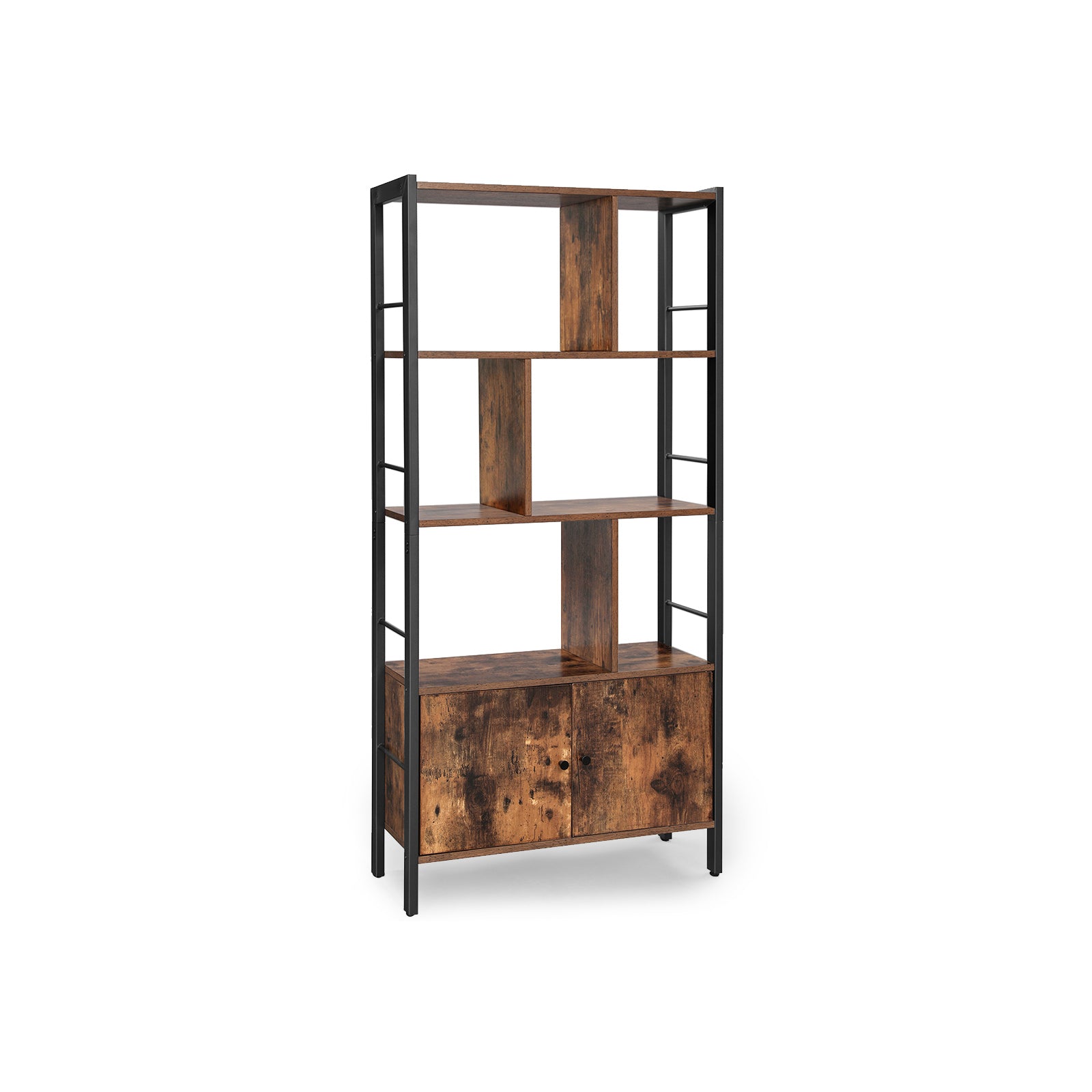
The VASAGLE LBC022B01 bookcase with cupboard is one existing catalogue option to compare. Its listed external size is approximately 74 cm wide, 30 cm deep and 154.5 cm high. It combines four open shelves with a lower two-door cupboard, using wood-effect engineered panels and a steel frame—not bespoke solid-wood joinery.
The mixed layout could suit a reading corner that also needs to hide cables or paperwork. Check internal openings, door swing, loads and the exact finish before buying. We have not tested it hands-on and it is not endorsed by Johnson.
Affiliate links: we may earn commission from qualifying purchases. Amazon uses our existing catalogue model reference; eBay opens search results, not verified stock. Confirm model, condition, price, seller and delivery with the retailer.
Make room for the less photogenic things
Leave a place for books waiting to be read, files and the objects that otherwise end up on the floor. Open shelves work best when you are happy to see their contents. A cupboard makes more sense for loose paperwork or mismatched supplies. Compare the trade-off in our open-shelves versus cupboard guide.
Try rearranging one existing shelf first. You may need a better allocation of space rather than more furniture. The aim is a room that supports reading and working, not a celebrity-home replica. Manor Furniture is independent of Johnson and Architectural Digest.