A dressing table needs enough usable top space for daily routines while leaving comfortable knee room and a mirror position that works when seated. Drawers, mirrors and stools all change the space you need around it.
Quick answer: will you be able to sit and use it?
Check three separate spaces: the clear opening under the drawers, the stool’s pulled-out position and your seated view in the mirror. Overall table height and width cannot establish any of these. Ask the retailer for missing internal measurements before ordering.
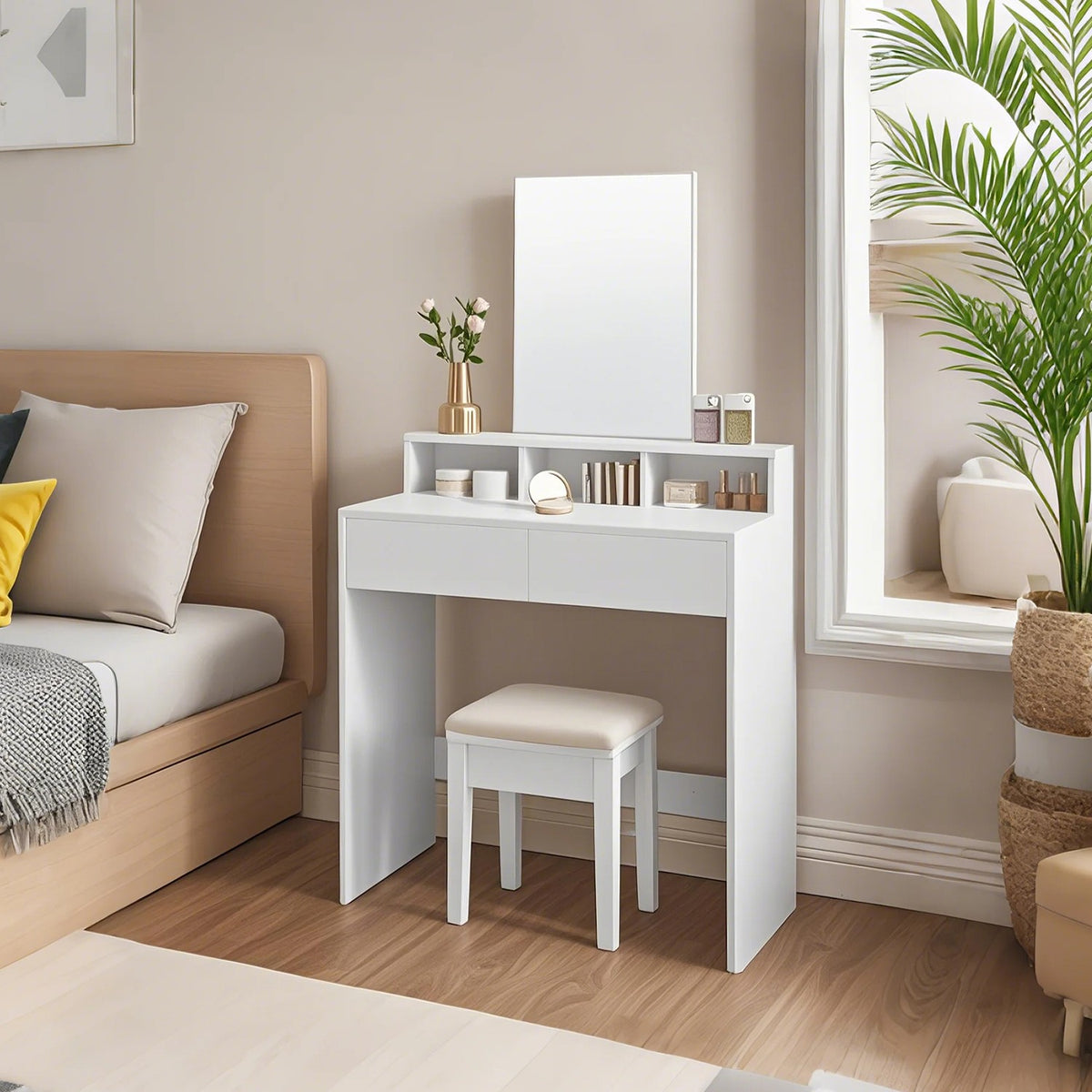
Measure the tabletop
Check the usable width and depth rather than the overall decorative footprint. Consider where cosmetics, jewellery, lighting and a mirror will sit, and whether everyday items will crowd the area you need for a mirror or lamp.
Check knee room and drawer clearance
Drawers beneath the top reduce the clear height and width for the user. Measure the space from the floor to the underside of the table, then check that your stool fits and the drawers can still open while it is stored.
Plan the stool
If a stool is included, check its width and height and whether it fits fully beneath the table. If it is not included, allow for the stool you intend to use and enough room to pull it out without blocking a doorway.
Check mirror height and position
Fixed and tri-fold mirrors need to suit the seated eye line. Also check the total height against windows, shelves and sloping ceilings. A mirror that opens or folds may need extra clearance at the sides.
Allow for power and lighting
LED mirrors and charging points need safe socket access and cable routing. Check where the cable exits and avoid trapping it behind the unit or across a walkway.
Compact example: VASAGLE UKRB35DT113W01
The VASAGLE rectangular-mirror dressing table is listed as 60 cm wide and 127 cm high for model UKRB35DT113W01. Its current product record does not give a working depth, so verify the depth, mirror position and whether a stool is included with the retailer before deciding if it suits a narrow room.
Browse our dressing tables and compare exact dimensions, stool arrangements and storage layouts.
Test the mirror position without buying the table
- Use the chair or stool you intend to keep. Sit at the proposed table position in your normal posture.
- Ask someone to hold a small mirror at the proposed position, or use an existing mirror safely supported nearby. Check whether you can see comfortably without leaning forward or hunching.
- Mark the table depth and check where a fixed mirror would sit relative to your face. A deeper top can place a non-adjustable mirror farther away.
- Check reflections and light at the time you expect to use it. A bright window behind your head or a poorly positioned lamp can make the same setup less useful.
This is a placement test, not a substitute for the manufacturer’s mounting and electrical instructions. Do not balance a heavy mirror or use temporary supports as a permanent installation.
The measurements to request if they are missing
- Clear knee-opening width, height and depth, measured beneath the lowest obstruction.
- Stool size and seat height, whether it is included, and whether it stores fully underneath.
- Drawer projection when fully open and any interference with the stool.
- Mirror size, whether its angle adjusts, and the complete height above the floor.
- Depth including any rear supports, plus required fixing and cable clearance.
Keep a separate note for each model rather than assuming two similar-looking white vanities share the same dimensions. For the whole-room footprint and current catalogue examples, see our dressing-table space guide. Use this page for the seated mirror and knee-room checks; use that guide to plan the furniture’s position.